
Cultural Intellectual Property Month
For the 5th consecutive year
‘Cultural Intellectual Property Rights are Human Rights’ is the theme for Cultural Intellectual Property Month.
The reason this theme needs a decade of attention is because it challenges mainstream conceptions of ownership, wellbeing and universal knowledge which took centuries to establish dominance.

Five years ago we proposed 'Cultural Intellectual Property Rights are Human Rights' as a decade-long theme to honor the knowledge systems, creativity, wisdom and innovation of Indigenous Peoples as well as autochthonous Local Communities, and call for the respect and full and effective protection of their pre-existing rights in relation to Traditional Knowledge (TK) and Traditional Cultural Expressions (TCEs)—rights that long predate conventional Intellectual Property systems. TK and TCEs are living knowledge, identity, and connection. Recognising them as inseparable from one another and legally protecting them is essential to fairness, dignity, and cultural survival.
Happening in April each year, Cultural Intellectual Property Month - in short Cultural IP Month - is a space for weaving dialogues and a catalyst for systemic change in fashion and law.
In 2026 the Keyword is CARE.
Inherent to Indigenous as well as local communities’ Customary laws, CARE lies at the heart of Indigenous and traditional Knowledge Systems: care for land, culture, community, and future generations. This inherent obligation of care is not only foundational to the continuity of these Knowledge Systems, but increasingly relevant in addressing today’s global challenges.
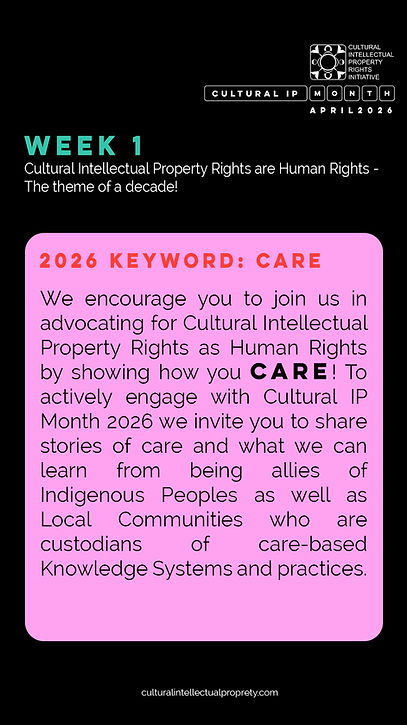
Send us your stories and contributions here and they will be published* on the CIPRI Blog this Cultural IP Month!
*Publishing requierments:
Text: 300-600 words
Images: min. 2 high quality images with credits
and permission to publish
Can also be illustrations, visual storytelling
with minimal text - min. 150 words,
poetry, reading recommendations

The Treaty is meant to support a more effective implementation of access and benefit-sharing rules in relation to GRs and associated TK, prevent biopiracy and misappropriation. The journey to the adoption of this Treaty took 25 years.
The 1st Intellectual Property treaty to refer to Indigenous Peoples as well as Local Communities, the Treaty establishes an international requirement for patent applicants to disclose the country of origin or source of the genetic resources (GRs) and associated Traditional Knowledge for inventions based on them. The Treaty will enter into force three months after the 15th instrument of accession or ratification has been deposited (Art.17 of the Treaty).

Read more here!

El cuidado, es una referencia de práctica en el Lekil Kuxlejal, que implica mantener la armonía de la naturaleza, mantener los ciclos de la vida y sostener vínculos de paz comunitarios. Enfatizando que el cuidado es colectivo y no, individual.
Care is a core element within Lekil Kuxlejal, involving the maintenance of harmony with nature, the continuity of life cycles, and the sustenance of peaceful community relationships. It emphasizes that care is collective, not individual.
Text by Helena Rojas
Read more here!
In Spanish and English


On practicing CARE:
Voices of CIPRI INDIA here!
PREVIOUSLY ON
Cultural Intellectual Property Month


Mindshifts are catalysists for systemic-change.
There is no greater force for change.
Our beliefs, perceptions and attitudes develop from our experiences and inform our behaviour and habits.
Being open to shifting our mindset based on our new understandings and values is a personal growth and care approach to changing systems.
Each Monday, from 8th to 29th April, building upon the outcomes of the 2023 Cultural Intellectual Property Month Red Thread Report, we will launch on the Blog an opinion piece and a Big Idea meant to spark critical dialogues and inspire systemic-change.
We train our minds to imagine alternative paradigms to the ones that favour extractivism, egocentrism and dissociation.
Read more about the theme and how to contribute - here!
MOnday 8th April 2024

Big Idea: "Cultural Sustainability requires legal frameworks that foster a culture of care, self-determination and reciprocity."
Call for Action: "Embrace vocabularies and frameworks that foster care and reciprocity and enable self-determination. Ask Indigenous peoples, ethnic groups and local communities what are the principles that guide their governance systems and practices? Help reflect them in the law. Start with influencing the legal frameworks where you have direct decision-making power: contracts.
The legal principle of freedom of contract is a powerful tool that allows parties to design their own terms and rules of engagement. We often used this tool, among others, to integrate the 3C RULE CONSENT. CREDIT. COMPENSATION™ in contracts that benefit Indigenous People, ethnic groups and local communities and affirm custodianship of their Traditional Knowledge, Traditional Cultural Expressions, biodiversity areas and territories."
Monica Boța-Moisin
Read the full thread here!
MONDAY 15th APRIL 2024

Big Idea: "Cultural Sustainability in fashion requires a rights-based approach for a legally grounded pathway to equity and social justice through creativity."
Call for Action: "Think critically about your position in the world. Educate yourself about Cultural Intellectual Property Rights®, Cultural Sustainability and the 3C RULE CONSENT CREDIT COMPENSATION™ to develop an understanding of a rights-based approach to design and the intersection between law, fashion, cultural heritage and biocultural diversity.
Connect with your local communities to develop authentic relationships without a business agenda and research the story of the land and people on which you live, work and source from. Feel your worldviews, your priorities and purpose shift. Look at your design practice and consumption choices through this transformed lens. Initiate conversations with like minded people to discuss your journey, ideas and challenges for implementing a rights-based approach in your personal and professional life."
Nicole Crouch
Read the full thread here!
MONDAY 22nd APRIL 2024

Big Idea: "At the heart of heritage creation and recreation is the concept of continuity. Cultural Sustainability is about continuity."
Call for Action: "We call our readers and network to identify Heritage Custodians around them and try to play their part in understanding their role in being active parts of their community without being disrespectful. Know ways in which you can do your bit. Some actionable steps that you can take are, educating and immersing yourself, be a part of Cultural Sustainability Academy - The Knowledge Hub for Cultural Sustainability®.
The community at Cultural Intellectual Property Month 2024, Cultural Intellectual Property Rights Initiative® is here to support and guide. Reachout to us and become Weavers of Change for Cultural Sustainability."
Shravani Deshmukh
Read the full thread here!
MONDAY 29th APRIL 2024

Big Idea: "Cultural diversity and biological diversity are intrinsically linked. When cultural diversity is lost, biodiversity is lost and vice-versa."
Call for Action: "Reframing. Instead of breaking natural laws down to concepts like biomimicry, environmental sustainability, climate change - how can we see ourselves in relation to natural laws? Living in communion with nature is a practice and a value that should inform our actions, laws and policies.
At Cultural Sustainability Academy - The Knowledge Hub for Cultural Sustainability® we relearn how to reintegrate communion with nature in our lives, in policy and decision-making processes.
Communion with nature - a holistic relationship of interdependence and interconnectedness that sees humans and nature as kin (relatives), with a shared ancestry and a shared future. It can have a spiritual nuance. I learned it growing up in my local community, and it is a universal value lived and practice in communities all over the world."
Monica Boța-Moisin
Read the full thread here!