
Exploring Cultural Intellectual Property Month 2026 A Red Thread Report

Cultural Intellectual Property Rights are Human Rights - the theme of a decade!

On 26 April 2026, the Cultural Intellectual Property Rights Initiative® (CIPRI) celebrated its 8 year anniversary. For the past 5 years during the month of April, the CIPRI Core Team facilitated the Cultural Intellectual Property Month, focused on the theme of a decade: Cultural Intellectual Property Rights are Human Rights.
This year marks the halfway point of amplifying this theme as a contribution to systemic change in the conventional IP system and creative industries by enabling full and effective protection of the rights of Indigenous Peoples as well as Local Communities and their Traditional Knowledge (TK) and Traditional Cultural Expressions (TCEs).
CIPRI’s unique approach focuses on legalizing CARE and RESPONSIBILITY and recognising sui-generis rights to collective custodians of Traditional Cultural Expressions and Traditional Knowledge systems. And from all the years of us committing to this path, we have seen that it requires the right network of individuals, organisations and communities to engage with CARE, accountability and responsibility.
The 2026 Cultural IP Month Keyword is CARE
Inherent to Indigenous as well as Local Communities’ Customary laws or Lore , CARE lies at the heart of Indigenous and Traditional Knowledge systems: care for land, culture, community, and future generations. This inherent obligation of CARE is not only foundational to the continuity of these knowledge systems, but increasingly relevant in addressing today’s global challenges.
This Cultural IP Month, CIPRI shared Knowledge Drops, pluriversal approaches to CARE from the CIPRI Network, and how CARE is manifested by the CIPRI Core Team and in the CIPRI Network.
The Journey to the WIPO Treaty on Genetic Resources and Associated Traditional Knowledge, a book by Wend Wendland, former Director of the WIPO TK Division, discusses the first conventional intellectual property treaty to refer to Indigenous Peoples as well as Local Communities and the IP system’s first step towards acknowledging the importance of their perspectives, needs, and aspirations. The WIPO Treaty on Intellectual Property, Genetic Resources and Associated Traditional Knowledge (“the GRATK Treaty”) establishes an international requirement for patent applications to disclose the country of origin or source of the genetic resources (GRs) and associated Traditional Knowledge (TK) for inventions based on them aiming to prevent the erroneous grant of patents for inventions that are not novel or inventive in relation to GRs and associated TK.
The Treaty will enter into force three months after 15 eligible State Parties have deposited their instruments of ratification or accession. So far, only 3 State Parties have done so.
From the Pluriverse
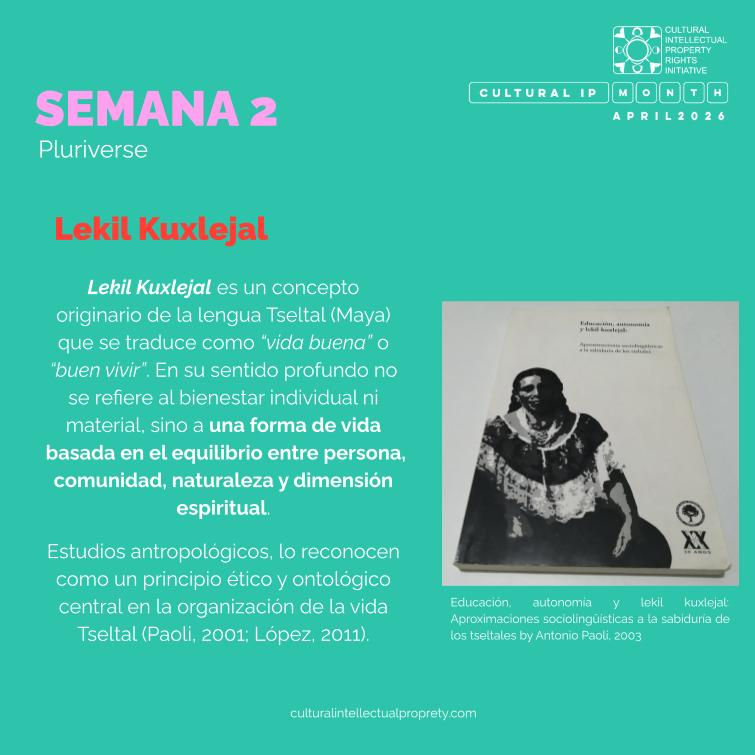
Pluriversal approaches to CARE such as Lekil Kuxlejal and Caring for Country are explored in Cultural IP Month 2026. Lekil Kuxlejal is a concept originating from the Tseltal and Tsotzil (Maya) languages that translates as ‘good life’ or ‘living well’, referring to a way of life based on the relational balance among people, community, nature, spirituality and the quality of interactions amongst them. Although the term appears in academic studies, it is an ancestral worldview, recognised as the central ethical ontological principle of Tseltal and Tsotzil life.
Caring for Country is at the heart of Aboriginal and Torres Strait Islander Peoples worldviews and their relation to “lands, seas, water, rocks, animals, winds and all the beings that exist in and make up a place, including people” *(Bawaka Country, 2020). There are more than 200 different language groups in the mainland and Torres Strait, where ancestral knowledge is formed from their relationship with the lands, waters, skies and beings that live on their Country. The term not only refers to environmental management and outcomes but the social, cultural, political and emotional well being of Aboriginal and Torres Strait Islander Peoples and their identity, health and autonomy, not just for themselves but for the benefit of the wider community and all Australians.
CARE is central to both Lekil Kuxlegal and Caring for Country and informs healing ways to move forward with our relationship with the rest of life on Earth. In recent years Lekil Kuxlejal has been incorporated into public and social policies as an opportunity to reclaim collective ways of thinking in the face of extractive practices and the Anthropocene. CARE in Lekil Kuxlejal involves the collective maintenance of harmony with nature, community and ecosystems. CARE is embedded in Caring for Country, in the customary laws and ways of life that Aboriginal and Torres Strait Islander Peoples inherited from their ancestors. These systems of knowledge and ways of being in the world should be protected through both Cultural Intellectual Property Rights® (CIPR) and Indigenous Cultural and Intellectual Property (ICIP).


CARE is central to our vision and work at the Cultural Intellectual Property Rights Initiative® (CIPRI) and the CIPRI Network
From the CIPRI Core Team to our Network members, CARE manifests by creating spaces for, and being involved in, conversations that act as a catalyst for systems change, as deep listening and openness to dialogue is the first step towards impactful action. CARE in the CIPRI community extends to how relationships and collaborations are woven and sustained. This is evident in the way we engage with the communities, groups and individuals we work with, the collective decision making processes we nurture, and the ways in which we craft partnerships.
Voices of the CIPRI Network say it in their own words: to Studio Bagru, CARE means paying attention, being unhurried and responsive as a sustained practice of awareness. To the United Artisans of Kutch, CARE means nurturing our local ecosystems and the rights of knowledge custodians. To Pitambar India, CARE means accountability, awareness and action.
CARE is often actioned by communal, relational and largely unwritten knowledge (Studio Bagru). It is often actioned by reaching out to custodians in source communities who often live in remote villages and linking them with conscious and caring individuals and businesses across the world to ensure their economic sustainability (United Artisans of Kutch). Care is also actioned by implementing safe practices, ethical materials and dignity in production, not as a label, but as a choice (Pitambar India).
We ask you to think about how is CARE reflected in your practice? And how can collective CARE become central to your way of being and acting in the world? Does it mean learning about ancestral approaches to CARE embedded in the Traditional Knowledge systems of Indigenous Peoples as well as Local Communities? Does it mean being actively involved in policy and governance through small actions like finding out if your Country has ratified the GRATK Treaty? Does it mean joining the CIPRI Network and becoming a systems-change Weaver?
An Invitation to Join us!
In April 2022, we launched Cultural Intellectual Property Month with a theme of a decade - Cultural Intellectual Property Rights are Human Rights. In 2023, we highlighted the importance of building trust and alliances, we engaged in conversations and learned from the lived realities of our Allies across four continents. In 2024, we focused on Mindshifts, those deep transformative processes necessary for systemic-change. How can we collectively change our mindsets and practice the understanding that CARE is the law of all things? In 2025, we focused on the force of the Collective. Collective awareness, collective action, collective wellbeing, collective custodianship rights - core to the work we do at the Cultural Intellectual Property Rights Initiative® (CIPRI).
It is evident with each Cultural IP Month that CARE manifests in many different forms. CARE from a Cultural Intellectual Property perspective is not about complying with a checklist, but understanding yourself: the land you come from, the social constructs you come from, the values you live by and what you CARE about in the world.
After 5 years of Cultural Intellectual Property Month, we have witnessed developments in awareness, vocabularies, approaches to practice, and impacts on hearts and minds across industry, academia, government and other actors in an effort to engage with Cultural Intellectual Property Rights® (CIPR). To continue this momentum, we invite those who resonate with this work to be a part of the CIPRI ecosystem.
If this resonates with you and you want to walk together on this journey, fill this form and join us!
Yours,
The CIPRI Core Team
*Bawaka Country: Mitchell, A, Wright, S, Suchet-Pearson, S, Lloyd, K, Burarrwanga L, Ganambarr, R, Ganambarr-Stubbs, M, Ganambarr, B, Maymuru, D, Maymuru, R, 2020, ‘Dukarr lakarama: Listening to Guwak, talking back to space colonization’, Political Geography, vol 81, https://doi.org/10.1016/j.polgeo.2020.102218, https://www.sciencedirect.com/science/article/pii/S0962629818304086


Comments